Domes
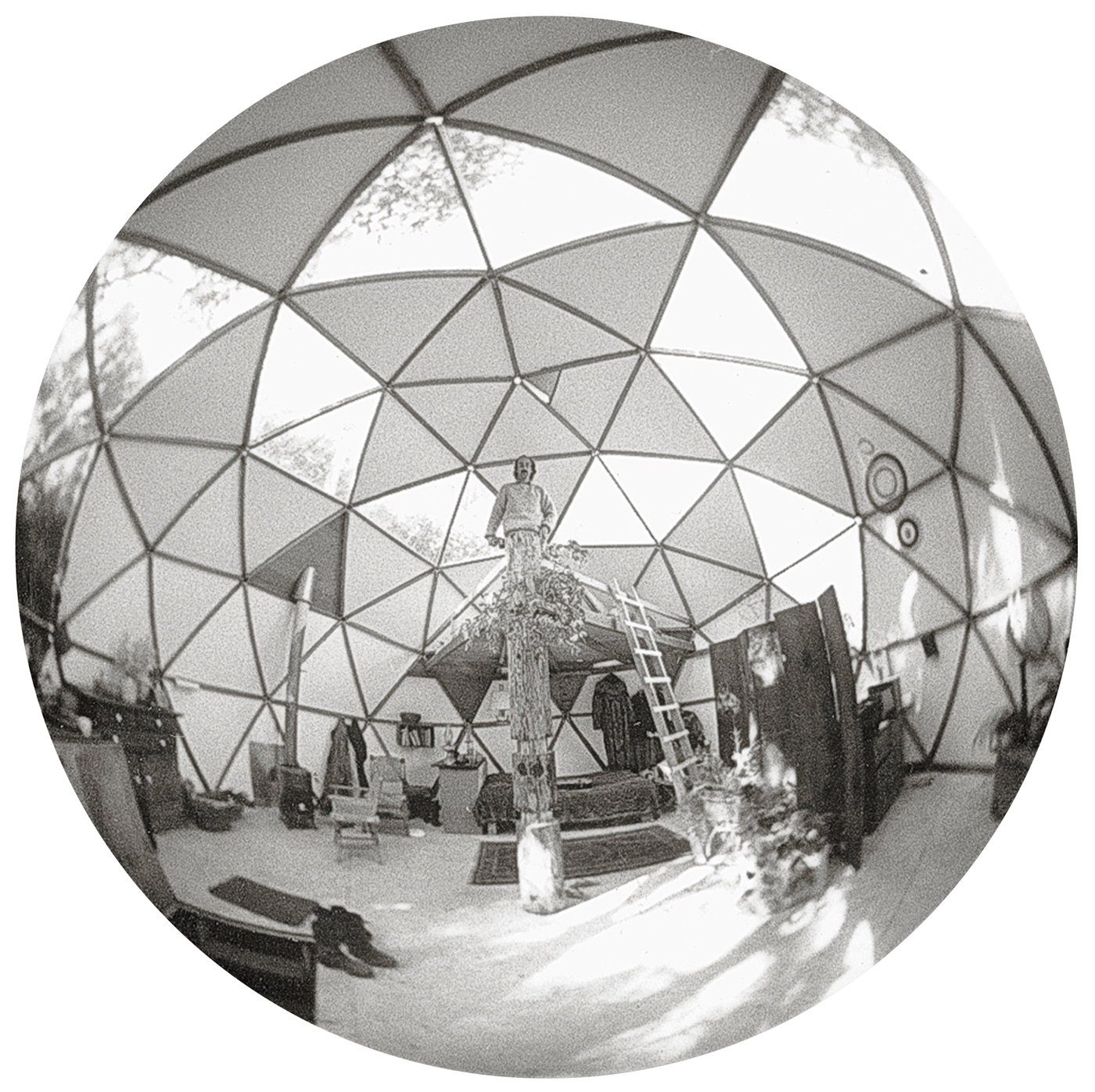
Refried Domes
It was the call last night that finally did it. “Lloyd, a friend of mine just built a dome in Big Sur and wants to know what to cover it with.”
A few days earlier there had been the call from a dome designer I’d met back in the dome glory days. He said there was so much call for information that now he was looking to republish a book he’d written on domebuilding.
— Deja vu, all over again. As Yogi Berra said.
I started building domes in Big Sur in 1966. Then in 1969 I spent two years overseeing a domebuilding program at an “alternative” high school in the California hills. We had to house about 50 students and a dozen or so teachers. We were inspired by Buckminster Fuller to work on solving “mankind’s” housing problems, and we took it upon ourselves to experiment with as many materials as possible. We built domes out of plywood, aluminum, sheet metal, fiberglass, ferro-cement, cedar shingles, asphalt shingles, and even nitrogen-inflated vinyl pillows.
With all the interest in domes and other alternative concepts of the times, and due to the extent of our dome design and experimentation, we soon became the focus and clearing house for the counterculture’s domebuilding movement of the late ’60s/’70s.
By 1970 it was obvious that there was enough information and interest for some type of publication. We borrowed the Whole Earth Catalog’s production facilities and in 1970 producedDomebook One and then in 1971 Domebook 2, which went on to sell 175,000 copies. Throughout this time we maintained a network of dome builders and designers.
By then we had built 17 domes at Pacific High School, and to tell the truth, the workmanship was less than exquisite. The time factor (just a few months to beat the rains), the age factor (teenage workmanship), the cost factor ($1200 per dome), and of course, the dope factor, all took their toll in the fine product. Yet we learned a lot.
Two years was about as long as the school lasted in full force. Things began to deteriorate on all fronts (for one thing, 50-odd teenagers do not make a good living situation) and I left the school in 1971 and bought a lot in a small coastal town. I wanted to try building one last dome on my own, without the constraints of communal living. This one I built carefully. It had a lightweight exposed wooden framework inside and was paneled with used reddish rough-sawn Douglas fir. The exterior was covered with redwood shakes that I split from driftwood logs and there was a long plexiglas skylight that focused on a pine tree outside. It ended up being featured in a two-page color spread in Lifemagazine.
By then I was getting even more calls and letters (and drive-by/drop-in unannounced visitors) and all the attention made me think very carefully about domes. I liked this dome far better than any I’d ever been in, but the problems of dome construction and dome living did nothing but increase. It had by now been five years of growing frustration and the disadvantages were overwhelmingly obvious. Domes weren’t practical, economical or aesthetically tolerable — at least for my life and sensibilities.
Finally, for a variety of reasons I sold the dome and dismantled it. At the same time we discontinued publication of Domebook 2,even though it was still selling well.
A cycle completed, a process carried full circle: mission impossible . . . .
We then went on to publish two more books on building: Shelter(1973) and Shelter II (1978). The first of these was even more popular than Domebook 2. It showed an intriguing variety of building methods from all over the world and a richness of human spirit in people providing their own shelter. Both these books outlined the advantages of rectilinear construction (and most notably stud-frame construction) for building one’s own home in North America. The disadvantages of domes were also well documented.
Yet since that time — in fact since Domebook 2 went out of print in 1973 — we’ve had a steady stream of calls and letters on domes:what do you think of them as homes, do they leak, where can I find chord factors, can I trust dome salesmen . . . We kept meaning to print something up, but the years slipped by.
As I said, the call the other night did it. The same old questions, 16 years later, but now increasing in frequency. (Maybe a lot of thebad ideas of the ’60s are resurfacing now along with the good ones.) Enough procrastination! Here’s our answer to all those dome questions. This hastily-assembled publication has a two-fold purpose:
To present our hard-earned opinion of domes as homes. (They don’t work.)
To reprint some long out-of-print mathematical information from Domebook 2. (Models do work.)
Along the way there are comments on plastics and “appropriate” technology, letters from readers, insights on mega-design and the little-known story of the world’s first geodesic dome.
The other day a friend asked what we were working on. “Well, this thing called Refried Domes, about why domes don’t work…etc.
“Aren’t domes passé?” she asked.
No, I said, there’s apparently a whole new generation of people out there now asking questions again. And then it occurred to me that although we did publish most of the information herein 10-15 years ago, it was never assembled as a whole.
Here then are the results of an experimental voyage. The bitter and the sweet. The great idea (!) and the concrete reality. The ideological principle and the physical follow through . . . Mamas, don’t let your mathematicians grow up to become builders . . .
— Lloyd Kahn
October, 1989
Smart But Not Wise
Further Thoughts on Domebook 2, Plastics, and Whiteman Technology
by Lloyd Kahn
“He looked upon us as sophisticated children – smart but not wise.”
–
Saxton T. Pope
(said of Ishi)
This article was prepared a year after publication of Domebook 2, reflecting then, as now, our changing views and evolution of thoughts on shelter.
”Those who cannot remember the past are doomed to repeat it.”
— George Santayana
1863-1952
Metaphorically, our work on domes now appears to us to have been smart: mathematics, computers, new materials, plastics. Yet reevaluation of our actual building experiments, publications, and feedback from others leads us to emphasize that there continue to be many unsolved problems with dome homes. Difficulties in making the curved shapes livable, short lives of modern materials, and as-yet-unsolved detail and weatherproofing problems.
We now realize that there will be no wondrous new solution to housing, that our work, though perhaps smart, was by no means wise. In the past year, we have discovered that there is far more to learn from wisdom of the past: from structures shaped by imagination, not mathematics, and built of materials appearing naturally on the earth, than from any further extension of whiteman technoplastic prowess.
In May, 1972, about a year after we published Domebook 2, I received an invitation to participate in a conference at MIT Responsive Housebuilding Technology. Out of curiosity I decided to go, not thinking too much about the fact that I’d been invited as the editor of the Domebook, and that since that time I’d more or less given up on domes and was disillusioned with new materials and high technology as applied to building. I decided to bring along slides and videotapes of house building in Northern California: shacks, driftwood buildings, interviews with real builders, and on video, the contrast between a crane dropping in a prefab and 25 men picking up and moving a small building: Machine vs. human energy.
So my son Peter and I took off for Cambridge. Our first helicopter ride, from Sausalito, smelly exhaust, a dreadful machine, to the SF airport. Then in a 747, five hours to cross the country! The huge jet was not 1/5th full, a terrible waste of fuel. When I went into the bathroom, the finely built one piece aluminum washbasin and toilet stand gave me an insight into Buckminster Fuller’s ideas of housing. Since Bucky has been constantly traveling now for many years, he spends an enormous amount of time in planes. He has always loved machines and metal (see the Phantom Captain chapter in Nine Chains to the Moon) and his fascination with air flight and aerospace technology lead him to dig aluminum efficiency such as the 747 in-flight bathroom Bucky and many others (see Le Corbusier: Towards a New Architecture) think of houses as machines. Probably because machines were just beginning to demonstrate their remarkable clanking capabilities when Bucky and Le Corbusier were at impressionable ages, their image is of houses being mass-produced, standardized, and now computerized. But I’m getting ahead of myself.
Robot Architect
The conference turned out to contain some ideas of architecture which made me gasp. Even though MIT has published some excellent books on native structures, the dominant theme (ironically) of Responsive Housebuilding Technology was computerized plastic flash. Right around the corner from the conference room there was a large computer being worked on by students, staff and others. It’s in its own suite of rooms, with homey looking exposed wires running between machines, plexiglas panels so you can see the electronic wizardry, and rock and roll on the radio.
The computer is called “The Architecture Machine” and its creators seek to build an intelligent machine, one that they can have a dialogue with. Robot architect. It took me few days to figure out what the machine could do, and was being trained to do, but here it is, and realize dear reader, that this is architecture at a leading American university, and that the project is well funded, and well respected:
Meet the robot architect and its functions (with code names):
SEEK is a mechanical device hooked into the computer that will pick up, stack and rearrange cubical blocks on command from the computer. In a museum exhibition two years ago, the machine, which can handle 300 cubes, and a colony of 60 hamsters were put together. The idea was to have the computer stack the blocks in a way the hamsters liked. The hamsters tended to knock over the blocks, running in and out (looking for their natural environment, but this was overlooked by the researchers) and SEEK was to figure out which way the hamsters liked the blocks stacked, and arrange them in that manner. Apparently what happened was the hamsters didn’t like any way the machine stacked blocks, they didn’t like the blocks, they didn’t like being in the museum, and they just knocked blocks over. But the idea of it all, in the words of one of the computer team ” …If this idea was carried out in a peopled world, perhaps a giant SEEK could sense the behavior and actions of its people and provide a responsive, useful and friendly living space, better than what now exists …”
GREET is a doorway device of photocells which will recognize whoever passes through the doorway. Work is now in progress “testing the machine for ways of recognizing height, weight, stride, foot size, i.e. relatively constant characteristics.” A series of photocells will sense the silhouette of passers-through the door and will compare it with a dictionary of well-known silhouettes and say “Hello Richard,” or whatever, as you pass through. The voice part of the computer is called SPEAKEASY.
HUNCH is a project whereby the computer will be able to understand sketches. In this way the architect can feed his rough sketches in to the machine and the scribblings will be made into perfect curves or angles and speed up the design process.
There are other things the machine can do, like a three-TV screen unit which can display multi-images of the same scene from different points of view. But that is just a quick layman’s view of it.
Now, also hanging around at MIT are pneumatic structure designers. Air buildings have been used at fairs, exhibitions, ice rinks, and now the technology is well enough along so that architects are able to construct them. Artists started out several years ago with polyethylene, and some designers made nice enough looking structures so that now plastic manufacturers, schools, etc. are interested. They appeal to the consumer-oriented US public, as they are even newer than domes, and are flashier media architecture.
This computer/airbuilding/plastics thing that seemed to be on so many of these architects’ minds jarred me, as it seemed roughly parallel with a logical extension of some assumptions I’d made 3-4 years earlier on the idea of housebuilding technology. The assumption, encouraged for a time in my mind by Bucky Fuller, was that we will have to depend upon new technologies, new materials, new designs to solve the housing crisis on an overpopulated earth.
Some scant background: Looking for new solutions to making family sized houses led me into building and helping others with a good number of geodesic domes, We were inspired, we had a vision, and we were in a hurry — we had people waiting for a roof over their heads. We tried every material we could get cheap enough wood, plywood, cardboard, sheet metal, aluminum; fiberglass/Veetra cloth/ polypropylene/all manner of horrid chemical-caulks/vinyl/polyethylene/plexiglas/Lexan/ABS plastic/steel and on and on.
At this time I was intrigued with the space program, video, computer art, the Moog synthesizer — and I decided we would try any hi-tech application we could get our hands on. Our work at Pacific High School, as described in Domebook 2, was exploring materials. We stuck to geodesic geometry as it was simple and gave us a rather neutral framework to work with in each case. Our main work, often missed by people thinking of the dome work in architectural terms, was in the realm of materials. With each material, the builders there tried to create as aesthetically pleasing a space as possible.
In all this work, we tried just about any plastic we could obtain. What I found out is that compared to the publicity by oil/chemical/plastic industry, plastics are going to have a very limited application in housing of the future.
While plastics have certain limited building applications (such as plastic sewer pipe, which an amateur can assemble), it is highly unlikely that the use of oil/chemical derived materials will ever be of significant use as structural or cladding construction, for these reasons:
Plastics Have Short Lives
First, there are practical disadvantages to the use of plastics in building. They are extremely expensive compared to conventional building materials. This has caused me to think that the cost of a material is roughly proportionate to the ecological damage done to the earth in removing and refining it. To find, for example, a plastic material that will resist sunlight without cracking is extremely difficult, or expensive, or both. There are virtually no plastics developed that are cheap and durable enough to cover buildings on any scale. I recently went back to look over the 17 domes we built at Pacific High School, so these observations are based on experience plastic foam gets easily damaged if not coated with something hard, and to coat it with something hard is expensive; it gets knicked and gouged very soon. It also turns an ugly oily brown color if not painted.
Polyurethane foam is said not to burn by foam salesmen, and it is true that it doesn’t catch fire easily. But it is also true that once it does catch fire, it explodes like gasoline and releases poisonous cyanide gas. I’ve concluded that foam is strictly an insulation material, and even then to be avoided if possible due to cost, fire danger, pollution in its manufacture, and Poison danger to the applicator.
We used vinyl for windows and in some cases to cover entire domes. After living and working with it for a few years I have become repelled by the material. It-never loses its objectionable smell, it attracts and collects dust and although at first you think it is clear, after a while you realize that you are looking at trees and stars through a film of chemically rearranged oil. Vinyl continually loses molecules from its plasticizer, which accounts for the film you see on auto windshields — from vinyl seat covers. In Viet Nam some GI’s died from blood transfusions from vinyl bottles. This molecular migration probably also works subtly on your nervous system.
Fiberglass does a lot of things other plastics can’t, but I don’t like to work with it smells, has itchy glass fibers. Though it looks O.K. on surfboards, it is hard, shiny, unattractive to me as a building surface. We had some spectacularly bad results trusting in caulks. Of course our 16-year old workmanship at Pacific High School was not that accurate, but even with super fitting, we were trusting too much in claims of manufacturers and salesmen. After working with every possible kind of plastic clear or semi-clear window material, I’ve rediscovered glass. It is true that plexiglas doesn’t break and is easier to cut, but it scratches easily and permanently, attracts dust and dirt, and just never has the sparkling clear, image-transmitting capabilities of glass.
Secondly, here are some personal aesthetic discoveries I’ve made in spending a few years around various plastic materials (I’d lived previously with more conventional materials such as wood, concrete, glass, brick, etc.) I’ve found that the less molecular rearranging a material has undergone, the better it feels to be around. Wood, rock, adobe as compared with polyurethane foam and polycarbonate resin windows.
Oil or Wood
It occurred to me lately that there is a profound difference between the way wood and rock are produced, and the way plastic foam and flexible vinyl windows are manufactured. Consider that a tree is rendered into “building material” by the sun, with a beautiful arrangement of minerals, water, and air into a good smelling, strong, durable building material. Moreover, trees look good as they grow, they help purify air, provide shade, nuts to squirrels, and colors and textures on the landscape. And wood is the only building material we can regenerate. On the other hand, most plastics are derived by pumping nonrenewable oil from the earth, burning/ refining/ mixing it, with noxious fumes and poison in the rivers and ocean, etc. Of course, saw mills and lumber companies rip stuff up with gasoline motors and saws, and smoke fumes, but it-strikes me that the entire process of wood growing and cutting is preferable to the plastics production process. What is called for is tree-respecting forest management.
However, there are obviously many people who feel comfortable with items such as Tang, pink plastic hair curlers and the disposable dishes on airplanes. Discover your ideals as you take your choice.
I tend to feel uncomfortable around any oil-derived or highly processed plastic material. Polyurethane foam seem as if it would be better than the others, but it, too, turns out to be ugly.
In addition to the practical and aesthetic disadvantages I’ve found in plastics there is the idea that one is dealing with Dow, and the oil industry — that is the people Nixon worked for.
I’m still not afraid to use plastics, I just have a far more realistic picture of what they can do. It turns out, after several years of varied experimentation that plastics can’t stand the weather, or if they can they’re extremely expensive.
The foam builder tells us foam can be shredded up into mulch. Sure, I reply, it’s a good mulch, but it stays in the soil, and after you keep mulching with it, your soil becomes more and more plastic and less and less dirt. Pretty soon you can raise plastic flowers!
After the MIT conference, Peter and I drove out to Cape Cod, spent Friday night in an old inn. It was a beautifully built 100 year old wood building with an elliptical spiral staircase said to have been built by an itinerant carpenter who built three such staircases on the cape. Next to the inn was a large barn which was being converted into an art gallery. I had a drink with the owner in the inn’s small bar and we started talking about buildings. I asked about the barn, and he said, “Do you want to see it tonight?” “Sure.”
We walked into the large building in the darkness, and then he switched on the lights. It was about the most dramatic way to see a beautiful old building, the sudden blaze of lights revealed a 100 year old mortise and tenon structure. There were about four loft-levels, and at the top was a hexagonal cupola. The inn’s owner sensed something was going on with me in the barn, so he went back to the inn, telling me to stay there as long as I liked. I climbed up all the ladders, up all the stairs, looking at the joinery (wooden pegs.) Then up into the little cupola room which was above the roof line, smoked a joint, sat and looked out over miles of countryside in moonlight. To the north, the water. Sitting there, 50 feet high, supported by hundred year old wooden structure, the futuristic plastic building notions seemed strange indeed.
Machine Birth
The pilgrims actually landed in Provincetown, before Plymouth. One of the first things they did, according to folks in Provincetown, was to steal the Indians’ corn crop. I wish I knew more history. Where did this western technology start? Was it due to metals? Machines? Electricity? Resources? What started this thing that led to death of American Indians, much wildlife and forest, massive alteration of air, water and topography? What was the spirit that invaded this continent, machined its way to the Pacific Coast, then eventually got a stranglehold on most of the planet?
I sent an early draft of this writing to Bob Easton; here s part of his reply:
Science: got started by people studying the stars and biology for healing purposes. Certain principles of mechanics grew out of observing nature: stars, trees, animals. Leonardo. Newton. Etc.
The New World: Stories of fabulous riches in the East moved western man to explore and hoard — the development of consolidated power by the developing “nations” of Europe created this awareness of the Roman experience, of super abundance, superpower — lust for more riches, hoarding, super tribes competing for dominance by the ultimate in power display — the greatest accumulation of useless gems, gold. Ferdinand and Isabella. Henry VIII. The new world exploration breeds technology, better equipment to transport. Worship of material objects creates subsystem of technique necessary to masturbate this outrageous lust.
Slavery: The human slave was considered a machine by Romans, Greeks. European man in his exploitation of the New World riches could condone slavery abroad — possibly the church in its traditions dating back to Roman days would not allow slavery within Europe. The slave “machine” was profitable because it bred, needed cheap fuel, basically looked after itself, wasn’t paid; is the “robot” of thefuturists …
Slavery Ends: Outrage over conditions slaves are subjected to is voiced by humanists and artists of the 16th and 17th centuries — a new class — people who have moved thru the arrogance of accumulated objects into new levels of consciousness. These people bring tremendous pressure on the merchant/power/military class first in England, then the US, because they are of a higher class within the social hierarchy of the society…the children of the leaders (Dickens, Swift.) The pressure builds to end slavery — panic — the old order must change. The newly growing technical class is pressed by merchant leaders — possibly unconsciously — or perhaps independent innovators within the merchant class rise to meet the challenge — certainly within the circles of power and technique the fears were voiced. The biology scientist becomes the gross engineer.
The Answer: Watt develops the artificial heart, the steam engine, and the others all follow: machines analogous to the rest of the body, including the greatest of all, electricity, the machine equivalent to the life force itself. The answer is the mechanical/electrical slave, the great source of wealth that western man created all by himself. No other culture developed this. China’s war lords made gunpowder, etc., but is nothing compared to the incredible competitiveness of the fierce western white tribes. The new idea pioneered in America is now every man can have slaves — cars, labor saving devices, etc., plus the power high gotten off using power tools — the same high gotten off using slaves, basic to the small human ego, which is so susceptible to extending its range of influence and power.
However, the consumer-people of the western world are but children soon to be cast out of the warm cradle, because the monster slave has begun to die off: the young of today are instinctively cutting off its regeneration. The costs of using its services will soon begin a very rapid rise because of scarcity. The cost of gasoline, electricity, plastics will rise so they can only be bought by the industrialists to maintain their power. As the unions hoard the skilled jobs and knowledge, their power and wealth will die with them. As the medical professions develop more artificial drugs, the viruses will continue to grow more sophisticated to overcome those drugs and will kill off those who contact those germs/ viruses; since viruses only attack dead cells within the body, the ill-fed people/consumers will be susceptible to disease.
The next main stream culture will be made of the artists and humanists of today’s subculture. Why? There may be no alternative. It appears now that the ultimate tool of the techno-fantasy people, the computer, says to turn itself off. (See World Dynamics, by Jay W. Forrester, Wright-Allen Press, 1971.)
Why not listen to Bernard Maybeck who wrote:
”The artist suspects it is not the object nor the likeness of the object he is working for, but a particle of life behind the visible. Here he comes face to face with the real things of life; no assistance can be given him; he cannot hire a boy in gold buttons to open the door to the Muse (our italics), nor a clerk or accountant to do the drudgery. He is alone with his problem and drifts away from superficial portrayals. After this he strives to find the spiritual meaning of things …”
Above quote from booklet: The Palace of Fine Arts and Lagoon, by Bernard Maybeck, Paul Elder, 1915; quoted in Five California Architects by Esther McCov. Reinhold Publishing, 1960.
Man?
Now back to MIT. The computer people at MIT and the air building people have collaborated in various architectural visions. Example: an air building controlled by computer which recognizes people when they come in; and when say 60 people get into the building, the computer unrolls and blows up another plastic section to accommodate more people. The occupants have control over windows, for example — they can make windows appear or disappear. Computer allows occupants to change shape of building at will. “Hal, will you set the table for eight tonight?”
Another idea that’s been around for a while, that came up at MIT: architect draws on cathode tube with magnetic pencil; design for a foam house is fed into computer. Computer operates a foam truck with barrels of foam, boom, and extruding device. The truck boom manipulates around, extruding walls of the house. The house is built with no human hands touching it.
Wait! at this point, the last day of the conference, I started yelling. (Sym van der Ryn had been arguing with them earlier.)
”This is an architectural conference, there are no people here, just professionals playing academic futuristic games. No women, kids, men here to react to your ideas, academic insularity. Moreover, you designers, especially the ones with artistic abilities, are making plastics and a totally impractical and weird shelter outlook appear seductively appealing to those folks who are always looking for something new and flashy. Spacy air buildings are deceptive, that’s all. No one is ever going to really live that way, but it’s good media. The same thing I learned with domes, they photograph well.”
The planet needs nonpolluting energy sources. Solar heat, wind electricity, methane from compost. Revive waterwheels; sawmills in New Hampshire were driven by water power. Put 2/3rds of the staff at MIT on developing clean(er) burning motor vehicles! Create a mind bank with the Architecture Machine and come up with a solution to internal combustion before the Chinese have two cars per family! If successful you will be national heroes upon graduation, and receive free nonpolluting cars the rest of your natural lives.
Architects, use your skills and desirable positions to assist in current housing problems. Help people! You don’t have to find a gigantic new solution to housing. The answer may be in our hands. Whisk Whisk Whisk, the sound of 100,000 Chinese brooms sweeping snow off Peking streets. No snowplows. The excreta of Peking collected and used for fertilizer. No sewage problem.
MIT, architecture schools, have you ever considered that in some cases, designs get about as good as they’re going to get, and then don’t improve for millions of years. Look at our hand! Is there a need to redesign it? Have architects, builders ever considered that our grandparents, but more specially the Indians, built far more sensibly than today’s building industry? And that maybe looking for new structures and new materials isn’t that important right now? that you can’t think about building, or design unless you consider the lifestyle? And that the extravagant use of resources in the US now can’t last, and is in fact maintained at the expense of subjugated, bombed, exploited third world people everywhere?
I was particularly disturbed by the vision of the architect sitting at the cathode tube, drawing his design into the computer, the computer causing the foam truck to build the house. The ultimate in laziness, machine worship. Machine can do anything better than man if we develop machine enough, is the premise. Wrong! It’s going to look horrible — guaranteed — it’s going to cost too much, it’s going to be ecologically unsound, it will only produce environments that machines or machine-like people will want to inhabit.
John Ryckman of Montreal sent us a photo of a Thai man weaving a rainproof head shield with the following comment:
He never heard of “great circle theory” — doesn’t know geodesics from A,B,C, — and thinks Buckminister Fuller is nothing but a smooth-talking evil spirit!
So, there’s a lot of trickery and hype afoot, I ran into a good deal of it and wish to pass along my disillusionments for the edification of those who won’t therefore have to go through the same trial and error (much error!) process.
Buckminster Fuller’s description of man (from chapter, The Phantom Captain, Nine Chains to the Moon): Man?
A self balancing 28-jointed adapter-base biped; an electrochemical reduction plant, integral with segregated stowages of special energy extracts in storage batteries, for subsequent actuation of thousands of hydraulic and pneumatic pumps, with motors attached; 62,000 miles of capillaries; millions of warning signals, railroad and conveyor systems; crushers and cranes …
Hand-Owner-Self Built
Here is a quick summary of some shines I’ve learned about shelter:
Use of human hands is essential, at least in single-house structures. Human energy is produced in a clean manner, compared to oil-burning machines. We are writing for people who want to use hands to build.
It took me a long time to realize the formula:
Economy/Beauty/Durability: TimeYou’ve got to take time to make a good shelter. Manual human energy. For example, used lumber looks better than new lumber, but you’ve got to pull the nails, clean it, work with its irregularities. A rock wall takes far more time to build than a sprayed foam wall.
The best materials are those that come from close by, with the least processing possible. Wood is good in damp climates, which is where trees grow. In the desert where it is hot and you need good insulation there is no wood, but plenty of dirt, adobe. Thatch can be obtained in many places, and the only processing required is cutting it.
Plastics and computers are far overrated in their possible applications to housing.
There is a huge amount of information on building that has almost been lost. We’ll publish what we can, not out of nostalgia but because many of the 100 year old ways of building are more sensible right now. There are 80 year olds who remember how to build, and there are little-known books which we’ll be consulting in transmission of hand-owner-self-built shelter information.
Before I left home, Peter Warshall told me to be sure to see the Peabody Museum of the American Indian at Harvard. So the first day of the conference, and twice thereafter that week, we went over to Harvard, and I was truly staggered. Seeing these things in real life rather than pictures — so unbelievably beautiful! Since I like to work with my hands, I usually look at the way objects are made. Chumash baskets!! All hunting, religious, cooking implements are incredibly crafted, fashioned and ornamented by men and women in touch with the earth and its streams and breezes. Ingenious shelters! At the museum someone has made fine models of Indian villages with cutaways showing how their structures were built. There are even miniature baskets in the model settlements.
Walking amidst magnificence of Indian craftsmen with MIT dimly in mind, I realized that there may not be any wondrous new solution to housing at all. That there is far more to learn from wisdom of the past and from materials appearing naturally on the earth, than from any further extension of whiteman technoplastic prowess.
— Relics of the past (Indians)
vs
Visions of the future (MIT),
No contest.
We’ve been losing ground.
Domebuilder’s Blues
by George Oakes
Buckminster Fuller didn’t invent the geodesic dome. The first guy who stitched together a soccer ball did. Soccer balls are made up of the same configuration of hexagons and pentagons. Just take a soccer ball and cut it in half — in your mind’s eye, anyway — and you’ve got the basic design. As a matter of fact, the plutonium core of a nuclear weapon is put together exactly the same way. What Fuller did was to patent a panelized assembly. Each panel is a triangle made with 2 x 4 sides (struts), parallel studs within the triangle, and plywood skin on the outside. When bolted together, 60 of these panels make a dome.
To build a dome, you invite a bunch of friends and relatives who aren’t fast enough on the draw to think of an excuse for not pitching in, lay in a load of food and a keg of beer, and you sling up this kit, using a 3-stage, 15-foot scaffolding and 9/16" ratchet wrenches.
At 7 a.m., there’s nothing there but a foundation. By 7 p.m. or so, there is a 22-foot-high plywood-covered dome standing there, looking for all the world like an alien spaceship landed. One of my neighbors on Green Valley Road went hunting Friday evening. We put up our kit on Saturday, and when he came home Sunday afternoon he the called the sheriff’s department to report that UFO’s were coming down in Napa.
That’s as far as you get with the dome kit: a plywood shell. It looks like an enormous accomplishment, but it is really only about one percent of the finished house. The dome will not support anything but itself, so if you want a loft or second floor, you have to build another house inside the one you just built. You also have to learn how to deal with non-standard angles. I had to move the kitchen range three feet because the oven door, it turned out, was going to get stuck in an acute angle. It looked a lot simpler on the floor plan.
The floor plan is nearly circular. Anyway you slice it up, you come out with wedge-shaped corners somewhere. And if you make one room larger, the floor space has to come out of some other room. You can’t just make the house larger. There are places you can’t put windows in downstairs, because you can’t pierce the lower parts of the dome without weakening it. In all the brochures, they stress that once you have the dome built, you can put anything you like in it. In fact, you’re operating under a number of restrictions imposed by the shape.
Somewhere along the line, you also discover that contractors like working on domes the way they like having double pneumonia. At first, you think it’s because they are reactionary or else mentally retarded. Later, you realize it’s because they can tell just by looking at the job approximately how much labor it’s going to consume. They can also tell just by looking at you that you don’t have enough money to make it worth their while. If you do manage to wangle a bid out of a contractor, he’ll make it astronomical, on the theory that it will either: a) scare you off; or b) assure him of a profit if you accept it. Contractors who have worked on dome houses all swear that they’ll never do another. I’ve heard that from a roofer, from a sheet rocker, and from a local electrical contracting company. Eventually, the only people who will take work on domes are the folks who sold you your dome kit. And my butt is black and blue from self-inflicted kickings for having had anything to do with my suppliers.
George Oakes sent us this article in 1981. What was true about domes then, still is. Models, yes. Homes, no way!
In brief, these are the chief technical drawbacks. I discovered them all the hard way, so I know them well. It goes without saying that I did not anticipate any of them before starting:
The only kind of insulation you can legally use in a dome kit is super-expensive, flammable, poisonous, and unbelievably labor-intensive to install.
The very shape of the house makes it difficult to conform to code requirements for placement of sewer vents and chimneys.
Domes are difficult to roof. And if not roofed exceptionally well, they will leak like a sieve.
All building materials come in rectangular shapes off the shelf. They have to be cut to fit triangular and other non-standard shapes. Scrap from cutting -i.e., waste — ranges from about 10 percent to 20 percent, depending on the type of material, of what you paid for.
Domes require about twice as much sparking tape and electrical cable as conventional houses of similar size. Cable costs quite a bit, and labor costs are doubled, too.
Foundations are critical. You can get away with a lot in conventional houses, but not with a dome.
Fire escapes are problematical, they’re required, and they’re expensive. Windows conforming to code can cost anywhere from 5 to 15 times as much as windows in conventional houses.
Insulation
This is a horror story. California law (Title 24, Administrative Code) sets insulation standards for each county based on meteorology. The more northern the county, the higher the standards. Modoc County, for instance, has a standard for ceiling insulation of R-38. Napa County, where I built my dome, requires R-l9 in ceilings. You may be familiar with fiberglass insulation. It’s thick and fluffy, and it’s easy to work with. You can cut it with scissors, and it’s just the right width for stuffing into the space between studs (14-1/2"). It’s also non-combustible, and it fills up the airspace in outer walls in such a manner as to prevent a draft from feeding a fire.
It didn’t occur to me to think about it until I was already well into my project, but a friendly building inspector pointed out to me that the “Company X” (a well-known dome company) kit, whose panels are only 3" deep, cannot be insulated with fiberglass. It’s not the fiberglass itself, but the air trapped inside it, that does the insulating. R-19 fiberglass is 6" thick, and while you can squash it down to 3" to pack into the Company X panel, you wind up with R11, which is legal only for walls. Most of the dome is ceiling.
Is there anything on the market that will give you R-l9 in 3" thickness or less? Yes, indeed. Solid plastic foam. Chemically, isocyanurate. Two inches has a value of R-19.
You can’t cut plastic foam board with scissors. You have to use a power saw. Each piece must be precisely measured to get a good fit. Too loose, and you lose heat — and the thing will keep falling out. Too tight, and you have to pare, scrape, pound and curse for a half-hour, while swaying up on top of a 25-foot extension ladder, your forehead beaded up with the cold sweat of acrophobic terror. An uncoordinated oaf with no training in carpentry could insulate a medium-size house in two days, using nothing more complicated than scissors and a staple gun. Three days blindfolded. The Company X kit requires 14 different cuts, all containing weird angles. It took me three weeks with hired help to put in the plastic R-l9. Where I could legally use R-11, in the walls, I put in the fiberglass myself in one day.
That’s not all. There’s cost. Square foot for square foot as purchased, plastic foam costs about 4 times as much as fiberglass. It’s a petroleum product — 40 percent from OPEC. It comes in 4 x 8 foot billets, not in 14-1/2" wide strips. When you rip it to the right width, you’re left with a remainder 4-1/2" wide and 8 feet long. It’s unusable. And it’s 10 per cent of what you paid for at the lumberyard. Then you have to cut the rest into little triangles, trapezoids, parallelograms and what-have-you. This produces another pile of scrap coming to another 10 percent. The stuff was expensive when you bought it. It’s substantially more expensive when you throw away one-fifth of it. It doesn’t end there.
Two inches of foam leaves an inch of air space to feed your fire, God forbid. And the foam itself is highly flammable. If my place ever catches fire, it’ll go up like a 747 crashing on takeoff.– The code requires for this reason that plastic insulation must be finished over with at least 1/2" of gypsum: sheetrock, which is fire resistant. If you wanted to finish your interior with anything but gypsum board, forget it. Or else do it twice, once with sheetrock and then again with, say, your fancy hardwood paneling. And you remember the chemical nomenclature for this foam? Iso-cyan-urate. Look at the middle part of the word. When it burns, it gives off cyanide gas. It’s related chemically to the foam the airlines had to take out of their seating after it was discovered that the cyanide that killed Mrs. Hunt in that crash at O’Hare right after the Watergate break-in was not administered by the CIA but by a burning seat cushion.
In fairness, there are kits framed with 2 x 6 lumber, which give you plenty of space for R-19 fiberglass. This won’t– do you any good in Modoc County, however, and the kit is really expensive, since it contains twice as many board feet of lumber as the 2 x 4 kit. The panels also weigh over 200 lbs. apiece, which is going to make assembly interesting. There’s room for no more than three men on top of that 15-foot scaffolding, and they have to maneuver each panel into place by hand to make a fit with the adjoining panels, holding on with one hand while placing and ratcheting bolts in place with the other. Shipping costs are by the ton, and Company X doesn’t pay the freight from Oregon to you. You do.
Waste of Time and Materials
People who work in construction for a living do everything in modules of 4 and 8 feet. The reason is that almost all building materials are cut to those dimensions. Neophyte builders — like me — think that swinging a hammer is what eats up the time. Absolutely wrong. It’s measuring, cutting and fitting. Smart builders — unlike me — plan all of their work around off-the-shelf materials to minimize labor expended in trying to make things fit.
It goes without saying that your local lumber yard doesn’t sell anything made in triangular shapes. And where you do find the 8-foot module in the Company X kit it’s for the manufacturer’s convenience, not yours. Dimensions in a dome diminish toward the inside. The bases of the triangles in the 39-foot kit are 96" across on the outside, 94-1/2" on the inside. You have to measure, mark and pare off the extra 1-1/2". Where the dome intersects with flat planes (walls, ceilings, floors of your loft), the geometry becomes quite complex. I may be just slow, but I did take four years of math in high school. I once spent two hours whittling on a piece of sheetrock about four square feet in area trying to make it fit, because it had three non-standard angles in it.
I couldn’t get a contractor to bid on my sheetrock, so I did it myself. I got an estimate from a contractor I know for the taping of the sheetrock. He didn’t want to do it, he just estimated how much he would bid if he were interested, which he wasn’t. $3500 for labor alone. That’s for putting on about $10 worth of paper tape. Seems taping knives are made for 180-degree (flat) joints and for 90 degree (corner) joints, but there isn’t a thing on the market that will handle 147-degree joints. Tapers use a machine called a bazooka that enables one man to tape an entire house in a day. It goes without saying that it won’t work in the joints you typically find in a geodesic dome. You have to do it all by hand. It took me a month. I realize that I’m not skilled, but it would have taken me only two weeks if I hadn’t been building a dome. Taking a break from taping one day, I figured out how many feet of tape had gone into my old rectangular, unimaginative, non-glossy-color-photo ranch-style house I had sold in order to finance this wonderful experience I was now having. 1500 linear feet for 1500 square feet of floor area. The dome also has 1500 square feet of floor, but it took 3000 feet of tape — twice as much.
Electrical cable can’t go straight from one receptacle to another. It has to snake around hither and yon. Every time you have to make a bend in its course, you have to stop and pull it all through at that point before proceeding on. I talked to the electrician at the electrical supply place I bought my hardware from, and we compared notes. He was wiring another dome up county in Oakville and consoled me by saying that it was not just because I was a beginner that I was having such a hard time with the wiring. He was too, and he’d been in the trade for 20 years. He said something, too, that I heard from every other contractor I ever talked to who had done any work on a geodesic dome: never again.
We lost to cutting about 10 percent of our roofing material, 15 percent of our sheetrock, and 20 percent of our King’s Ransom brand solid plastic foam insulation. I didn’t measure the scrappage rate for lumber, but I figure I’ve got a 3-year firewood supply. So all is not lost. Unfortunately, when you burn Douglas fir 2 x 4s, you pay by the board foot, not by the cord.
Plumbing
The Uniform Plumbing Code requires that sewer vents terminate no less than 10 feet from any openable window. If you build a dome with a cupola on top, as I did, there is no place on the surface of the dome that is not within 10 feet of an openable window suitable for venting upstairs plumbing, unless you run flying pipe across your esthetic 22-foot-high ceiling. There is a shortage of places to vent even downstairs plumbing, since you can’t pierce the lower parts of the dome. I wound up with 14 feet of castiron pipe from my illegal sewer vents — knowingly installed by a dome company, our local Company X franchisee — to a point 3 feet above said openable windows, which is the other way it is legal to vent sewer gases.
Heating
Promotional literature on dome houses claims that they are easier to heat. For one thing, the sphere has less surface area per cubic unit of volume enclosed than any other shape. Given equal window-space and wall and ceiling insulation, an elongated rectangle (your typical ranch-style) has about 20-25 percent more surface area than the dome for the same amount of floor space.
Once again, I sat down and calculated how much surface area my old clunker had. It was 20 percent more than the dome. Built to the same standards as the dome, it would require 20 percent more fuel to heat to the same temperature. But if I had built a house like my old one and doubled up the ceiling insulation, which is easy to do in a conventional house, it would have required one-third less heat than the dome I was now building. The other reason that domes are supposed to be easier to heat — promotional literature again — is that they have superior air circulation characteristics. In fact, hot air stratifies at the top of the house, which is built like an inverted funnel. You don’t get the benefit of it unless you’re 18 feet tall.
Roofing
Water flows downhill. The steeper the slope — in roofing terms, the higher the pitch — the better off you are. Gravity does half the work of keeping the rain out. It’s an ill wind that will blow rainwater back up under the shingles of a well-pitched roof. A dome has 7 different pitches, ranging from near-vertical to near-horizontal. The topmost part of the kit must be roofed with tar and gravel or some other seamless membrane. I’m getting tired of saying it goes without saying — but it does — that roofing a low-pitched roof is more expensive than just nailing down shingles.
Another hazard of roofing domes is that every joint between panels is a potential leaker. Wooden shingles don’t go around corners. Everybody who has ever roofed a dome with cedar shakes has wound up with soggy sheetrock. The only practical answer is composition shingles, which are easy to nail down but which “burn out” in about 10 years and have to be replaced. This is quite a major concern when your house is two thirds roof. You can go expensive and buy fiberglass-base composition shingle, which last about 30 years. Even so, when they have to be replaced, the cost will be disproportionately more than for the guy who built a long, rectangular roof. He probably roofed it himself and pocketed the difference (I got one estimate from a pro who had done a dome before: $9000 for labor only, plus materials). I finally managed to get a contractor to do the job for only $1200. He did a fine job, and it leaked in only one problem place.
Foundation Work
Domes have an engineering peculiarity that has plagued builders since the Emperor Justinian built Hagia Sophia. The dome does not just press downward on the bearing walls, it makes them want to fall outward, too. All domed structures (and Gothic cathedrals, whose roofs have the same defect) built before the invention of structural steel concrete are buttressed on the outside to keep the walls from falling down.
The riser wall of the dome kit is made to be buttressed internally. Wing walls on each side of the riser are strapped to it with stout steel straps. The wing walls are strapped down to the concrete. These straps must be placed precisely in order to match up to the lumber they are meant to be attached to. When it’s all together, the wing walls rein in the riser wall to prevent collapse.
Ventilation
When air is heated, it picks up extra quantities of water vapor. Most people don’t realize it, but building materials are not impermeable. Gases permeate and pass right through sheetrock, lumber, and stucco all the time. The greater the temperature difference between inside and outside, the more gas diffuses through. It is inhibited by insulation, which is made, after all, to trap air.
When the temperature in the space between inside and outside reaches the dew point, the water vapor liquefies. There are virtually no conditions under which it will revaporize. Over time, water accumulates in the spaces between studs, promoting dry rot. The really bad place is in the ceiling, because that’s where the hottest air accumulates, driving the water vapor through the sheetrock like a 20-ounce hammer driving a 16-penny sinker into a Doug fir 2 x 4 . Code requires that the air space above ceiling insulation be ventilated, to blow away the water vapor before it can condense.
The upper portions of the geodesic dome are built just exactly the same way as the lower portions. Panels are plywood and roofing on one side, sheetrock on the other. 2 x 4 studs and struts in between, air spaces packed with insulation. No way can it be ventilated. But if you add on a cupola, there is a possibility: put in a dropped ceiling, then ventilate above that. The plans that came with my prefab dome kit and my cupola kit made no provision for this. I was stunned when I got a stop-work order from the Planning Department because of lacking ceiling ventilation. I had to build the ceiling inside-out (as it turned out, like everything else in the dome). It took me a week and $300 to do it, teetering all the while on a 2 x 12 plank 19 feet up. I was up there when the Livermore earthquake hit. My kit supplier, of course, refused to participate in the cost, citing an exception to the UBC section on ceiling ventilation. I telephoned the International Conference of Building Officials in Whittier to get a reading from them. They wrote the UBC. They told me the dome company was full of it. When I confronted the dome company with this information, they proceeded to upbraid me for “harassing” the ICBO.
My dome incorporates a lot of firsts. Mine is the first ever built with a dropped ceiling. It may be the last to collapse from dry rot. There are a lot of domes out there whose lumber is getting soggier and soggier with every heating season.
Windows
A bedroom is any room that doesn’t have a range or a toilet. An upstairs bedroom is required by code to have a fire escape,. i.e., a window with certain minimum dimensions of open area. Most window are made to be installed vertically. There is no vertical surface on the outside of a dome. There are two ways to solve this problem. One is to build a dormer, and the other is to put in roof windows.
Building dormers on the outside of a dome requires cutting of lumber on compound angles. Most carpenters will not touch compound angles with a 10 foot 2 x 4. Simple angles are hard enough to get right. And compound miters are no job for a do-it-yourselfer like me, unless he has a week to experiment with each piece of lumber. The dome company, when we were still on speaking terms, estimated that they would charge about $1000 per dormer. That’s a lot of bread just for putting in one window.
I did another first. I bought roof windows imported from Denmark. I know That mine are the first ever installed in a geodesic dome, because I talked with the importer in Boston. These windows are so water-tight they’re seaworthy. they’re beautiful examples of fine European craftsmanship. But they cost $350 apiece. Of course, that’s only 5 times the cost of a normal window in a normal house, as opposed to 15 times, which is what the dormer will cost you. The $350 figure is in 1978 dollars, by the way. Norwegian woodstoves have gone up 50 percent since 1978. Danish roof windows can’t be far behind.
I’m just going to abbreviate “It Goes Without Saying.” IGWS, as beautiful as my roof windows are, as leakproof as they are, any window installed on the diagonal will let rain in if it’s inadvertently left open and you’re at the supermarket when the storm hits. A vertical window won’t ship water even when open unless the wind blows directly into it. You have to be paranoid about upstairs windows in a dome if you want to avoid ruined carpeting and subflooring, especially if you have children living upstairs. Dormers also create valleys in your roof, and valleys have a tendency to leak.
Living in Domes
Acoustics are excellent. It’s like living in two band shells glued together face to face. You can’t even pee without it reverberating from one side of the house to the other. My 9-year-old boy sounds like Yosemite Falls. There is no privacy. Privacy is something that doesn’t show in the glossy color photos in the brochures.
Light bounces around the same way sound does. I often have a bout of insomnia around 3 a.m. and have to get up and do something for about an hour to get sleepy again. Not only does it have to be something silent, it also has be done in the dark, because if you turn on one light, it’ll light up the whole house and wake everybody up.
Hanging pictures is a problem. Donate half your art and photos to a museum or Goodwill, depending on quality.
Code requires that chimneys terminate no less than 2 feet above a point at which the chimney is separated from the roof by a horizontal line of no less than 10 feet. On a dome, this means that you must build a 20-foot-high metal chime in order to place your woodstove or fire place near a peripheral wall with a thimble going through the wall. A 20-foot chimney must be braced with steel braces or heavy-gauge guy wires, which is unesthetic. You need a lot of them for 20 feet of pipe. To minimize on chimney and maximize on stove-pipe which heats your house and costs less than chimney-pipe, you put your wood heater in the middle of the house. This places it in the middle of the traffic pattern. When my Jotul is stoked up, it gets very hot. Children can collide with it. Guests can fall on it, burn themselves, and then sue you for all you’re worth. So either you’re worried about people getting hurt, or you’re nervous about what the next high wind will do to your 20-foot chimney. Something else to be paranoid about.
Placement of furniture: choices are limited. If you have a favorite 8 by 12 foot Oriental rug, make sure you provide for it in your building plans. Don’t wait to move in before you think about where to put it. It may be too late. And you can’t use it as a hanging, because there are no walls to hang it on.
Maybe It’s Just Me
I worried about it for a long time. I had never built a house before. My biggest project had been to convert a garage to a living room. When building inspectors heaped scorn on domes, I thought they were just sticks-in-the-mud. Others had done it. I had seen the glossy color photos of finished dome homes in the promotional literature.
I contacted others who were building domes. There are two others under construction in Napa County. The first one, in order of building starts, is being built by a dentist. He isn’t hurting for money. He can live in one house while he piddles around with the other. His hobby is building ships in bottles. The problems involved are quite similar to those you encounter in building domehomes. He’s been at it for four years now, and he’s just getting his sheetrock up. His rock man is a pro. I talked to him, and he said he was going to the cleaners over to the doctor’s house. He asked me if I could guess how many feet of tape it takes to do a dome. 3000? I asked as ingenuously as I could manage. His jaw dropped open, and when he regained the power of speech, he said: never again.
Number 2, also owner-built, has been under way for over two years. Reason it’s taking so long is that it was abandoned 18 months ago.
After a great deal of contemplation and soul-searching, I reluctantly came to the conclusion that considering everybody else’s experience, considering the reactions of contractors who have actually worked on dome houses, considering the geometry of the problems, it wasn’t just me. It was intrinsic to the shape.
Domes vs. Rectangles
A rectangular structure is built of walls, which are vertical, and a roof. The roof acts as an umbrella, keeping most (not wind-blown) moisture off the walls, windows and doors. A dome is all roof; water, including mists or fog, pours over the entire surface. Unless the dome is covered with shingles, the slightest pinhole causes leakage.
Rectangular buildings are shaped by available materials — wood, stone, adobe, etc. — and the laws of gravity. Domes are shaped by polyhedral geometry and materials must be forced to carry out the abstract concept.
The dome framework, due to its tightness, is continually under stress. As temperatures change it expands and contracts. It is always working, always straining at the seams.
Domes must be built of higher grade materials. The kiln-dried lumber required for framing is over twice as expensive as construction grade lumber used in stud framing. See cost comparison below.
Almost all building materials come in rectangular shapes. They must be altered to fit polyhedral shapes, either with resultant waste or more complicated cuts.Also, once materials are cut for dome assembly they are-difficult to recycle in another building.
A far greater variety of materials can be used in conventional construction: rock, adobe, used wood, doors and windows, construction grade lumber, etc.
An important feature of an owner-built home is the possibility for later expansion. With a perpendicular wall, you merely add on more roof and walls, all at 90°. With a.dome, however, you weaken the structure by cutting into it and must cut compound angles and tie into multiple facets when adding on.
Similarly, constructing interior partitions in a dome is far more time-consuming, due to the compound angles.
The dome’s well-publicized “more space for less materials” actually means more cubic area (overhead) that is hard to utilize and must be heated.
We are vertical to the earth. So are refrigerators, beds, bureaus, tables, kitchen counters, etc. These things fit best in a rectangular space, less efficiently in circular space.
Each triangular facet of a dome faces center; this magnifies noise. Also, smells circulate throughout the entire dome.